Technical weighbridge portal
Pit-mounted or above-ground weighbridge: which should you choose?
The difference between a pit-mounted weighbridge and an above-ground weighbridge does not concern the principle used to determine the vehicle weight. What changes is the way the structure is integrated into the yard and, consequently, the approaches, civil works, footprint and organisation of vehicle routes.
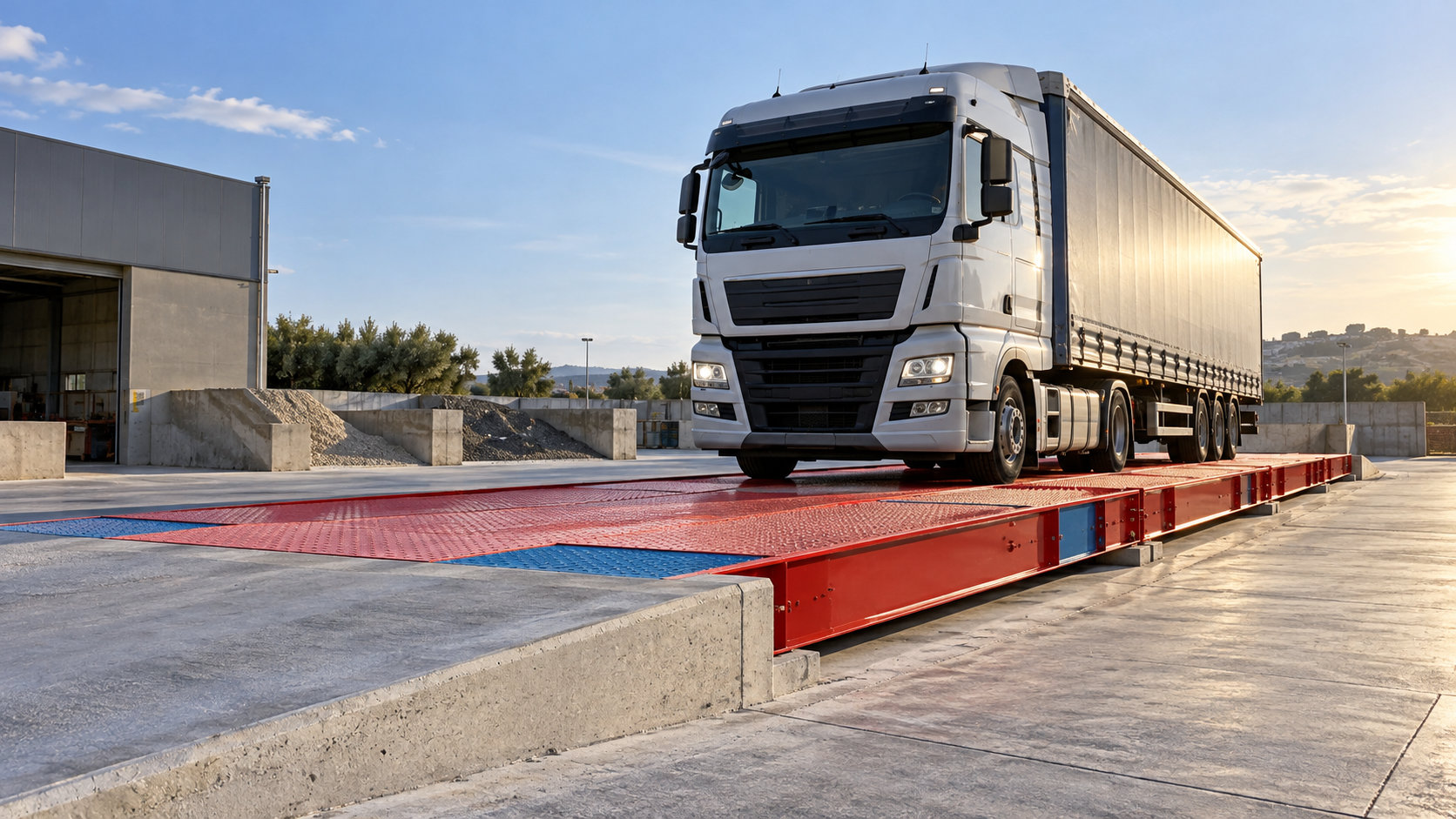
In a pit-mounted, or floor-level, configuration, the weighbridge deck is at the same level as the surrounding area, so the truck reaches the platform at yard level. In an above-ground, or over-floor, configuration, the structure remains raised and the vehicle reaches it via the approaches provided for in the project.
There is no solution that is always better. The right choice is the one that integrates most effectively with the available space and with the way vehicles enter, are weighed and continue along their route.
I Bilanciai produces modular varnished and hot-dip galvanised weighbridges available in both floor-level and over-floor versions. Installation type is therefore a design decision: it does not distinguish one weighing technology from another, but determines how the system becomes part of the yard.
In this guide
- Two different ways of integrating the weighbridge into the yard
- Pit-mounted weighbridge: what it really means
- Above-ground weighbridge: what changes
- Access and space: this is often where the decision is made
- Do not design a weighbridge around the footprint of a car
- Civil works: the weighbridge price is only part of the project
- Water and drainage: what cannot be seen still matters
- Inspection and maintenance: think about them before installation
- If the yard already exists, the choice becomes even more practical
- What about a new facility?
- Pit-mounted or above-ground: does the installation type affect accuracy?
- And the price? Does a pit-mounted or above-ground weighbridge cost less?
- Operational comparison: pit-mounted or above-ground
- When a pit-mounted weighbridge makes sense
- When an above-ground weighbridge makes sense
- Three questions that genuinely help with the choice
- A proper comparison starts with two equivalent weighbridges
- The right solution is the one that fits day-to-day operations
Two different ways of integrating the weighbridge into the yard
A weighbridge occupies more than the space taken up by the platform itself.
For the system to work properly, a truck must be able to reach it, align with it, drive fully onto the weighing deck, stop in the correct position for weighing and then clear the structure. All of this takes place in a yard where other vehicles, forklifts and personnel may be moving at the same time.
This is why the choice between pit-mounted and above-ground begins before the weighbridge itself.
With a floor-level installation, the weighing deck remains at yard level. With an over-floor installation, the vehicle route must instead be connected to the level of the raised platform.
The first solution places an important part of the project below ground level.
The second uses the space in front of and behind the weighbridge more visibly.
In both cases, the project must be designed around the actual vehicles that will use the installation.
Pit-mounted weighbridge: what it really means
The term pit-mounted weighbridge can create the impression of a machine simply 'placed in a hole'. That is an oversimplification.
The purpose of the installation is to bring the weighing deck to the same level as the yard.
Below that surface are the weighbridge structure, load cells and the elements required by the selected configuration. Civil works must therefore be designed to accommodate the system correctly and allow it to be used and maintained over time.
From a traffic-flow perspective, the most obvious advantage is continuity of the route: the truck does not have to climb onto a raised platform.
This can be particularly useful where space around the weighbridge is limited, vehicle traffic approaches from different directions, or a significant part of the yard cannot be dedicated to developing raised approaches.
The visible advantage at surface level, however, has to be considered together with what must be built below the traffic surface.
Excavation, foundations, levels and water management are just as much part of the choice as the weighbridge itself.
Above-ground weighbridge: what changes
In an over-floor installation, the weighbridge structure remains raised above yard level.
The truck must therefore reach the weighing deck via the approaches provided for in the project and leave the platform in the same way.
As a result, the space required for the installation is not limited to the length of the weighbridge itself, because it must also include the approaches and the areas needed for vehicle movement.
In a large yard with straight routes and sufficient space before and after the platform, this configuration can integrate very naturally.
But 'above-ground' does not mean 'without civil works'.
Foundations, supports, transition areas and yard works must be designed around the structure and the vehicles that will use the weighbridge. Technical truck-scale design guidance treats foundations and approaches as structural parts of the installation regardless of whether the weighbridge is installed in a pit or above ground.
The correct distinction is therefore not between a pit-mounted weighbridge that requires civil works and an above-ground weighbridge that does not. Both require a site project, but they use space, foundations and civil works in different ways.
Access and space: this is often where the decision is made
Before comparing prices and models, it is worth looking at a site plan.
You need to understand where the trucks come from, how they reach the weighbridge and where they have to go after weighing.
In particular, the following should be assessed:
- entry and exit trajectories;
- turning radii;
- space before and after the platform;
- waiting areas;
- buildings and fences;
- other internal traffic routes;
- yard levels;
- any interference with loading, unloading and material handling.
An above-ground weighbridge can be entirely practical when the yard allows the approaches to be developed without creating interference.
Where every metre matters, however, being able to reach a pit-mounted weighbridge directly at yard level can become a decisive factor.
This is why weighbridge length and total installation footprint are not the same thing.
An 18-metre weighbridge does not simply require an 18-metre rectangle in the yard. It has to be approached and cleared by a vehicle that may itself have significant dimensions and turning requirements.
Do not design a weighbridge around the footprint of a car
An articulated lorry does not turn like a car.
It may sound obvious, but many internal traffic problems arise precisely because a site plan considers the vehicle's static footprint rather than the movement required to position it correctly on the platform.
This applies to both configurations, but becomes particularly evident with above-ground installations.
Where the platform has defined approach routes, the driver must line the vehicle up correctly with the weighbridge. A location that is technically possible on paper may therefore prove inconvenient when it is used every day by articulated vehicles.
The assessment must therefore be based on the actual vehicles, because a rigid lorry, a truck with trailer and an articulated vehicle are not equivalent in terms of manoeuvring. The weighbridge must be designed for the vehicles that will actually arrive at the gate, not for a hypothetical 'average truck'.
Civil works: the weighbridge price is only part of the project
When comparing pit-mounted and above-ground weighbridges, it is easy to focus on the cost of the platform, but a sound economic comparison must consider two complete installations rather than two structures alone.
A pit-mounted configuration requires civil works that allow the structure to be installed while keeping the weighing deck at yard level.
An above-ground configuration avoids this type of pit installation, but still requires foundations and approaches suited to the raised platform.
The economic comparison should therefore include at least:
structure + foundations + civil works + approaches + yard works + installation + specified equipment.
Only then does it make sense to ask which of the two alternatives costs less.
It would be incorrect to state that a pit-mounted weighbridge is always more expensive, because the result depends on the site. A yard that is already prepared, a new facility, an area that must be rebuilt completely or a site with severe space constraints can lead to very different cost assessments. It is therefore more useful to ask what it costs to build a complete installation that will work correctly in that specific yard than to look for an abstract price for pit-mounted installation alone.

Water and drainage: what cannot be seen still matters
With a pit-mounted weighbridge, part of the installation is located below yard level.
Water management therefore has to be considered when the civil works are designed.
Rainfall, washing, site gradients and ground conditions are not matters to address after installation. Technical guidance for pit installations specifically treats drainage as one of the aspects that must be designed.
This does not mean that there is a standard solution valid for every weighbridge or every site.
Depth, foundations, drainage systems and construction details must be defined for the actual configuration, following the manufacturer's documentation and the civil-works design.
The key rule is simple: water must be considered before the weighbridge is built, not after the first heavy rainfall.
The yard and foundations must of course also be managed correctly with an above-ground installation. The form of the issue changes, not the need to address it.
Inspection and maintenance: think about them before installation
When choosing between pit-mounted and above-ground, it is also important to ask how the system components will be accessed in the years ahead.
Accessibility does not depend solely on whether the weighbridge is above or below yard level.
It depends on the structure, the configuration and the access arrangements provided for inspection.
I Bilanciai varnished weighbridges have a modular structure and inspection hatches for maintenance; they are available in both floor-level and over-floor versions.
For this reason, it is more useful at the design stage to check how a technician will actually reach the components of the specific installation than to assume that one configuration is inherently easier to maintain. The ability to carry out inspections and service work properly is determined when the weighbridge position, installation type and accessibility are defined.
If the yard already exists, the choice becomes even more practical
When a weighbridge has to be installed in an operating facility, the project does not start with a blank sheet.
Internal roads, gates, buildings, fences, loading and unloading areas, underground services, gradients and established vehicle routes already exist.
This is precisely where the comparison between pit-mounted and above-ground becomes especially practical.
If the yard is large and allows a straight approach to be created, an over-floor weighbridge can be integrated without complicating traffic flow.
If space is more constrained, or vehicles need to reach the weighing area from different routes, keeping the platform at yard level can provide greater design flexibility.
The choice must start from what already exists, observing the actual trucks and their routes before defining the position and configuration of the weighbridge.
If you already have a yard and want to understand which configuration can fit the available space more effectively, dimensions, vehicle routes and day-to-day use are the information needed to build a meaningful quotation.
What about a new facility?
When the weighbridge is designed together with the yard, the choice can be approached even more rationally.
Instead of adapting the weighbridge to an existing traffic layout, the opposite can be done: the weighing point, entrances, exits and operating areas can all be designed together.
The weighbridge can then be positioned along the vehicles' natural route, avoiding unnecessary detours and manoeuvres.
At this stage, it is useful to assess together:
- vehicle types;
- platform length;
- capacity;
- direction of traffic flows;
- first and second weighing;
- pit-mounted or above-ground installation;
- software;
- any self-service requirements;
- position of peripheral devices;
- inspection and maintenance access.
A decision made on a site plan costs far less than a change made after the concrete has already been poured.
WANT TO KNOW HOW MUCH YOUR WEIGHBRIDGE WILL COST?
Describe the vehicles, yard and intended use: the I Bilanciai team can identify the configuration that should be assessed in more detail.
Pit-mounted or above-ground: does the installation type affect accuracy?
Pit-mounted and above-ground installations do not use different weighing principles and, on their own, do not determine a different level of weighing accuracy.
In electronic weighbridges, the load is detected by load cells and converted into a weight value by the weighing system.
I Bilanciai produces modular varnished and hot-dip galvanised weighbridges in floor-level and over-floor configurations. The weighbridges use IP68 load cells and can be combined with the weight indicators specified for the project. All I Bilanciai weighbridges are made to measure.
It would therefore make no sense to choose a pit-mounted weighbridge because it is assumed to 'weigh better' than an above-ground one.
Installation type mainly concerns the relationship between the structure and the site.
Accuracy, conformity and measurement quality depend on the weighing system, correct installation and the conditions in which the instrument is used.
And the price? Does a pit-mounted or above-ground weighbridge cost less?
It is one of the most natural questions when buying a weighbridge.
It is also one of the hardest to answer with a single figure.
To compare the two solutions correctly, start with the same weighbridge:
same length, same capacity, same structure, same electronics and same equipment.
Then compare the differences introduced by the installation type:
- civil works;
- foundations;
- approaches;
- any excavation;
- yard works;
- site-specific conditions.
Only then does the comparison become meaningful.
I Bilanciai manufactures varnished and hot-dip galvanised steel weighbridges directly at its Barletta facility, making them to measure according to the vehicles, capacity, yard and operating requirements.
The quotation should therefore start from the installation actually required, not from the label 'pit-mounted' or 'above-ground' alone.
Operational comparison: pit-mounted or above-ground
| Aspect | Pit-mounted / floor-level | Above-ground / over-floor |
|---|---|---|
| Weighing deck | At yard level | Raised above yard level |
| Vehicle access | From traffic level | Via connected approaches |
| Approach development | Does not require an approach up to a raised platform level | Must include the space needed to reach the platform |
| Civil works | Must accommodate the structure below yard level | Foundations and civil works required for the structure and approaches |
| Water management | Particularly important for the below-ground section | Still has to be designed for the foundation and yard area |
| Inspection | To be assessed according to the configuration and the access provided | To be assessed according to the configuration and the access provided |
| Weighing principle | Unchanged | Unchanged |
| Selection criterion | Levels, layout, civil works and traffic flow | Space, approaches, layout and traffic flow |
The table is not intended to declare a winner.
It is intended to show where to look for the answer.
When a pit-mounted weighbridge makes sense
A pit-mounted configuration deserves particular consideration where keeping the weighing deck at yard level provides a real advantage for vehicle circulation.
It may be worth considering when:
- space available for approaches is limited;
- the yard has complex vehicle routes;
- maintaining a continuous traffic level simplifies vehicle movement;
- the civil-works configuration allows the pit installation to be built correctly.
Limited space for approaches is also identified in technical truck-scale design guidance as one of the factors that can favour a pit-mounted configuration.
The key point, however, remains the same:
the advantage gained at surface level must be compatible with what has to be built below it.
When an above-ground weighbridge makes sense
An over-floor configuration becomes particularly attractive when the site has enough space to organise approaches and vehicle routes correctly.
A large yard may allow the platform to be positioned along the vehicles' natural direction of travel and the approaches to be developed without interfering with other activities.
It is not enough, however, to check that the approaches fit geometrically on the site plan. The route must be assessed using the actual vehicles, their manoeuvres and the areas that have to remain available during normal facility operations.
When these conditions are favourable, an above-ground weighbridge can fit into the yard without forcing the entire traffic layout to revolve around the scale.
Three questions that genuinely help with the choice
How much space do I have once the trucks are taken into account as well?
Not just the area required by the platform. Approaches, manoeuvring space and waiting areas must also be included.
What civil works can I build?
Ground levels, site conditions and the structure of the yard can make one solution much more natural than the other.
How will the weighbridge be used every day?
A weighbridge crossed only occasionally and one used continuously for vehicles entering and leaving a facility have different operating requirements.
Once these three answers are clear, the choice between pit-mounted and above-ground becomes much less theoretical.
A proper comparison starts with two equivalent weighbridges
The simplest way to avoid a misleading comparison is to remove all variables that are unrelated to installation type.
To make the comparison meaningful, start with the same configuration—same length, same capacity, same structure, same electronics and same accessories—and design it once as a floor-level installation and once as an over-floor installation. It then becomes possible to compare:
- civil works;
- space;
- vehicle routes;
- approaches;
- water management;
- inspectability;
- total cost.
If the two weighbridges being compared differ in dimensions, capacity or equipment, it immediately becomes impossible to understand how much of the difference is actually due to choosing pit-mounted rather than above-ground installation.
The right solution is the one that fits day-to-day operations
A few months after installation, a well-designed weighbridge should no longer feel like an obstacle.
The truck arrives, reaches the weighing point naturally, positions itself, completes the operation and continues on its way.
Other vehicles continue to circulate.
The aim is an installation in which the civil works perform their function correctly and the components can be reached when necessary. Choosing between a pit-mounted and an above-ground weighbridge is therefore not simply a matter of deciding where to place a scale.
It means deciding how to integrate a measuring point into the company's day-to-day traffic flow.
QUICK ANSWERS
Frequently asked questions
What is the difference between a pit-mounted and an above-ground weighbridge?
With a pit-mounted weighbridge, also described as floor-level, the weighing deck is installed at the same level as the yard. With an above-ground, or over-floor, weighbridge, the platform remains raised and the vehicle reaches it via the approaches provided for in the project. The weighing principle is the same.
Does I Bilanciai produce both pit-mounted and above-ground weighbridges?
Yes. I Bilanciai produces modular varnished and hot-dip galvanised weighbridges in both floor-level and over-floor configurations. All are made to measure, with the configuration defined according to the vehicles, yard and site requirements.
Is a pit-mounted weighbridge more accurate than an above-ground one?
No. Installing the structure at floor level or over floor does not in itself determine greater measurement accuracy. The choice of installation type mainly concerns how the weighbridge is integrated into the yard.
When is a pit-mounted weighbridge the better choice?
When keeping the weighing deck at yard level provides a tangible advantage for traffic flow and the required civil works are compatible with the site. The space available for approaches is one of the factors to assess.
When is an above-ground weighbridge the better choice?
When the yard has enough space to connect the raised platform correctly and vehicle routes can be organised without interfering with other activities.
Does an above-ground weighbridge require no civil works?
No. Not requiring a pit installation does not mean that no civil works are needed. Foundations and approaches must be built according to the structure and the project.
Does a pit-mounted weighbridge take up less space?
It can reduce the space needed to raise the vehicle to the level of an elevated platform, but there is no rule that applies to every yard. The comparison must be made on the actual site plan, including vehicle trajectories and manoeuvres.
Which configuration costs less?
It depends on the project. A proper comparison must start from the same weighbridge and include foundations, civil works, approaches, any excavation and yard works. Comparing the price of the structure alone can be misleading.
Is water a problem for a pit-mounted weighbridge?
Water management is an aspect that must be addressed when designing below-ground installations. Drainage and construction details have to be defined according to the site and the applicable technical documentation.
Is maintenance easier with an above-ground weighbridge?
There is no universal rule. Accessibility depends on the structure and the project. I Bilanciai varnished weighbridges have inspection hatches for maintenance and can be installed either floor-level or over-floor.
I already have a yard: how do I know which configuration to choose?
Start with the site plan and the vehicles that will actually use the weighbridge. Entrances, exits, turning radii, available space, levels and feasible civil works make it possible to compare pit-mounted and above-ground options for the specific site. This is far more useful than any general rule.
Further reading
Technical sources
- The characteristics of the I Bilanciai configurations cited in this guide are based on the official documentation for the Varnished Weighbridge and Hot-dip Galvanized Weighbridge. General aspects concerning approach design, pit installations and civil works have also been compared with technical industry documentation.
Last technical review: 1 September 2026. Published by I BILANCIAI S.r.l.
TELL US ABOUT YOUR WEIGHING REQUIREMENTS
Provide the essential information. You do not need to know the model or configuration in advance.
I BILANCIAI S.r.l.
Via dell’Industria, 35
76121 Barletta (BT)
+39 0883 536146 / 334465
REQUEST A QUOTATION
Describe the operating context: your request will be handled by the I Bilanciai team.